Rabaed is a Saudi platform that brings the Owner, the Consultant and the Contractor on a construction project onto one documented, dated Record of every request and approval. It covers official correspondence, approvals and inspection requests, the daily site report, and versioned documents — every step recorded with who took it and when, kept after the project ends.
What problem does Rabaed solve?
The problem Rabaed solves is not email or Excel. It is that the process underneath them is manual and scattered: the request on WhatsApp, the approval in an old email thread, the status in a spreadsheet someone has to keep up to date. Rabaed makes the process itself one documented thing, instead of spreading it across tools.
These situations come up on almost every project, and each has a cost:
- The Contractor says the Consultant is holding up the work; the Consultant says nothing ever arrived — a dispute with no reference, and each side holding its own copy.
- Two Excel files, and two dates for the same document — hours lost to one question: where did this get to?
- The approval came by email months ago and nobody can find it — an approval that exists and cannot be proven.
- After the project ended we needed an old approval, and access to the shared folder was locked — the project’s record lost when the project ends.
Four units, and one Record that joins them
Rabaed covers the four units every transaction on a project passes through: official correspondence, approvals and inspection requests, the daily site report, and versioned documents. The four do not work each on its own: they all feed one Record, which is what sets the platform apart from four separate programs.
- Official correspondence: letters, minutes of meetings and RFIs with automatic reference numbers, and an automatic receipt that records who received what, and when.
- Approvals and requests: approvals of suppliers, materials and drawings, and work inspection requests (WIR), material inspection requests (MIR) and permits to work — and in the other direction, non-conformance reports (NCR) and site instructions.
- Daily site report: manpower, equipment, weather, the day’s progress and photos, sent from a phone on site and on the Owner’s dashboard at once.
- Documents and versions: one repository for the project, only the approved version visible to the site, and defined permissions for each party.
What is the documented Record?
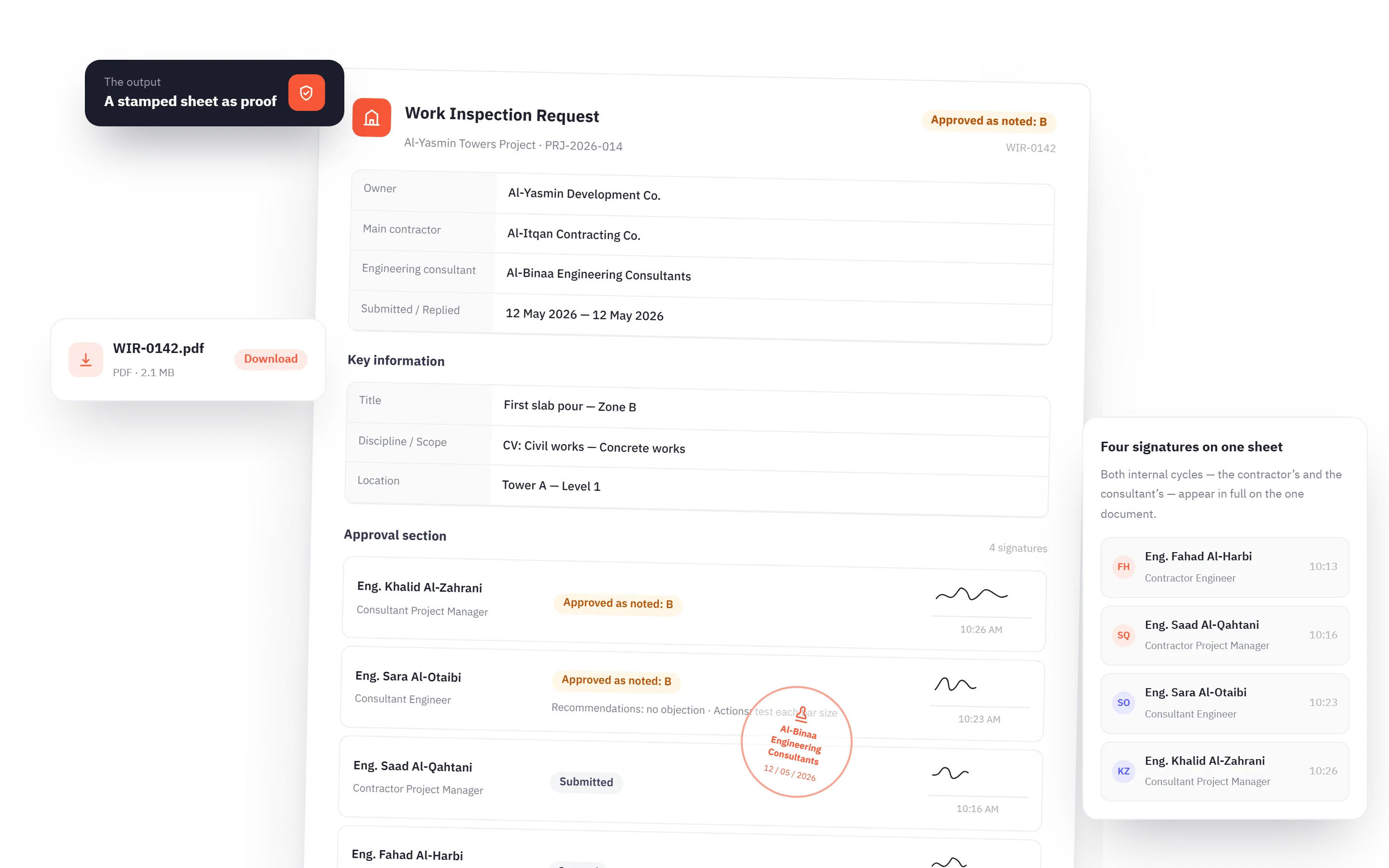
The documented Record is not a feature you switch on. It is what every step leaves behind. Any transaction that passes through Rabaed carries its whole history: when it was sent, who received it, who reviewed it, who approved it, with what comments, and when. That is why nobody on the project asks who approved something — they open the transaction.
An example from one work inspection request, begun and finished on the same day:
- Sent — Eng. Fahad, Contractor · 07:50
- Received — automatic receipt · 07:50
- Inspected on site — Eng. Sara, Consultant · 4 photos · 11:20
- Approved — compliant, cleared to pour · 12:05
The four steps are not messages scattered across four places: they are the document itself. A year later, or after the project has ended, the same Record is still there.
Who is it for?
Rabaed is built for all three parties on a construction project together, not for one of them: the Owner or developer, the Consultant, and the Contractor. Each sees what concerns them when they open the platform, and each party has a full internal review cycle the other two never see — only the official transaction crosses over.
- The Owner or developer: one dashboard for all your projects — what is waiting for your approval, what is past its deadline, and what happened on site today.
- The Consultant: the Contractor’s requests in one list with their status, and approval with your comments from the office or from site.
- The Contractor: one request instead of five messages — you know who received it and when, and its status without a phone call.
How do you get started?
Going live takes days, not months. The Rabaed team comes to the site, sets up the project, its forms and its parties, spends 15 minutes with each team, and everyone starts from where the project already is. Activation itself takes less than a day, with no pause in the work and no transition period.
And there is a 60-day guarantee from the date of activation: if you decide to stop within it, we refund the full amount paid and hand you a complete copy of your project’s Record. The details, and the common questions, are on the Get started page.